Showing posts with label quilting. Show all posts

I am NOT amused

Tracy wrote:

Ooohh, aaahhhh


AARRGH!


For those you who don't know what you're looking at, this is the backside of the bee-yoo-tiful and complicated quilting in the first picture. There was apparently a thread tension problem. Those bright spots are little and not-so-little loops of the front (and expensive) thread pulled through to the back. This is not good. I'll need to remove all of the stitching and re-do it.

Oh, and sorry if the second picture gives you motion sickness. I really WASN'T shaking with rage (or any other emotion)... though it occurs to me that it's been quite a while since breakfast...

Let the Quilting Begin!

Tracy wrote:

Woo-hoo! I've actually done some quilting on the first panel! Look!


Okay, so it's the back of the quilt. But the first round is quilted - the straight and incredibly hidden utility quilting, to keep everything lined up and stabilized. And wow, Jean, you were right - that black fabric just sucks all of the light into itself!

Time to press, stretch, press and quilt - 200 minutes, or 3/4 of "Honor Among Thieves" audio book (abridged), by Jeffrey Archer. I expect that the next one will not take quite as long.

(Oh, and that's Keith standing on a stool behind the quilt - remember, it's over 7 feet long.)

I've also identified the quilting motifs for the border and the kaleidoscope blocks. Now to trace them all out.... !

Auditioning Thread

Tracy wrote:

Although the utility quilting was done with black thread, the fancy quilting will be done with (mostly) fancy thread.

After dragging out some specialty threads that ranged from subtle to gaudy, Jean and I narrowed it down to a handful. After Jean went home, I narrowed it down some more (!)

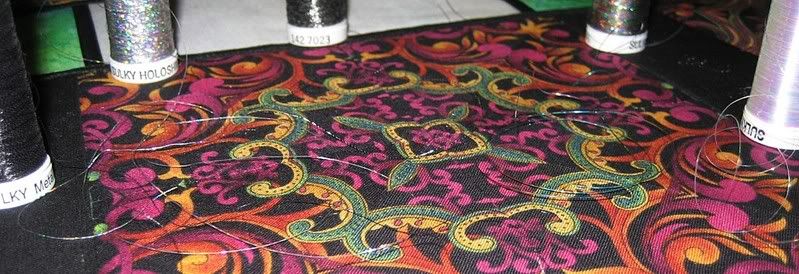
click to enlarge The first thing to do is to unravel a yard or two of thread from each spool and pile it up on the quilt top.

What I was looking for was something that had zing, but didn't set off my (fairly sensitive) gaudy-alarms.

I ended up with these possibilities/probabilities:


Top two are black rayon and silver holo[graphic]-shimmer; bottom (left to right) are black metallic, rainbow holo-shimmer and opalescent holo-shimmer

Eventually the black rayon was taken out of the mix, because of that whole "suck the light out" black Kona cotton thing. The rayon would only catch the light if a) the quilt was moved around or b) the light source moved - and since I don't expect either of those things to happen once the quadriad is installed, it got rejected.

Next up was to take the threads for a test drive, to see how they held up to the cotton, and if they had the proper zing. I encourage you to click on each picture to see the larger version:

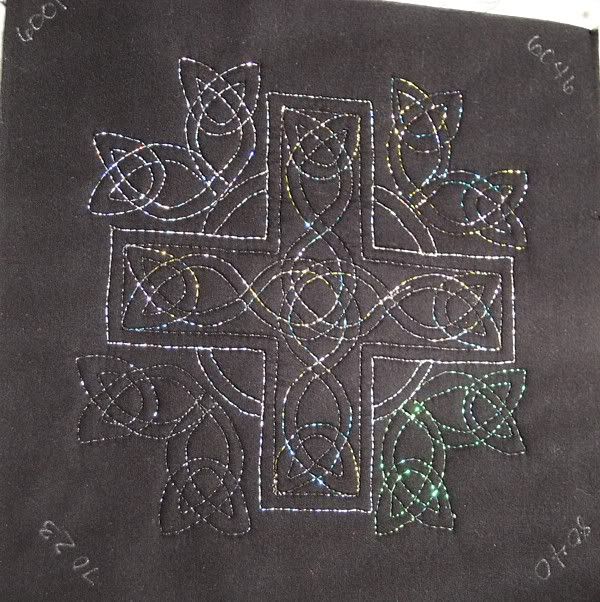
click to enlarge(This is NOT one of the motifs that will be going on the quilt.)

I quilted the motif using all four of the target threads - you can see where I've written their color number in the corners. The picture was taken in full-on sunlight so I could see maximum sparkle and determine if it was zing, or just plain gaudy.


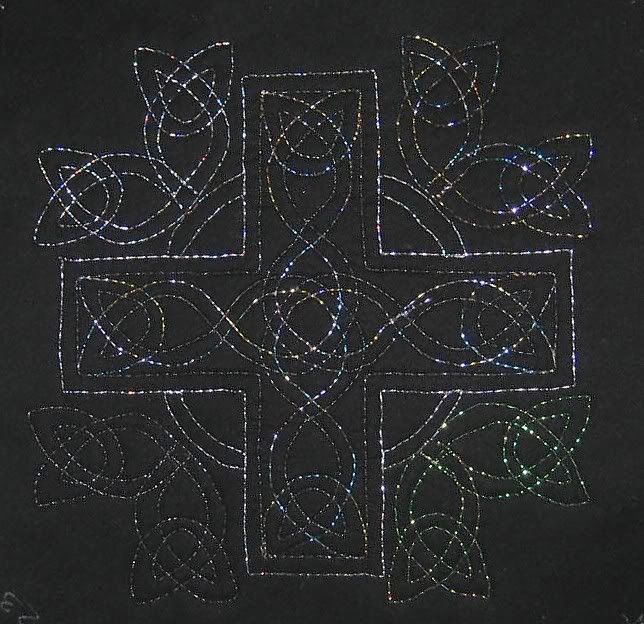
click to enlarge

Here it is again, in less dramatic lighting. The black here is much closer to real-life.


All of the threads passed the "test" on the suck-the-light-out cotton. They also behaved in the machine - metallic threads frequently shred in the eye of the needle - and the back of the sample even looked good!

Now that I've found the right threads, my next step is to call the quilting/fabric shops to see if these specific brands and colors are carried locally. I do NOT want to get partway through and have to change threads. You know that having different threads where they are supposed to be the same would send me over the edge.

You do know that, don't you?

She's not so quick, but she's clever

Tracy wrote:

I've been trying to keep track, and (based on the number of audio books that I've listened to), I'm at about 72 hours for machine quilting.

Yes, 72 hours sitting at my sewing machine.  I'm not telling you this because I'm looking for a poor baby.  No exclamations of awe are required.  It's just background to what I'm about to share.

I have to take my glasses off when machine quilting.  Usually I stick them in the neckline of my sweatshirt (greatly increasing the probability of smudges from my chin when I look down just so).  Sometimes I live dangerously and lay my glasses on my sewing table - running the risk of losing them amongst the clutter (and of course it's hard to look for my glasses when I can't see because I'm not wearing my glasses).

71.5 hours into my quilting odyssey, I had an idea.

Here's my cel-phone purse thing-y, larks-headed over the neck of my quilting floor lamp that's located between me and my sewing machine.


Where do I sign up for the local Mensa group?

I Only Make It Look Easy, Part One

Tracy wrote:

Okay, my last post mentioned the estimated number of hours I've spent at my sewing machine, just quilting and not sewing.

I am constantly amazed by the amount of time it takes me to quilt (actually, I'm amazed at the time it takes me to do pretty much anything at the sewing machine). I mean, it's sit down, sew one or maybe two squiggly lines and move on, right? Why, then, does it take me at least 45 minutes and usually over an hour to do one single block?

In an effort to document the how/what/when/where/why... well, that might be too ambitious, but let's try this, step by step.

First off, not even included in the at the sewing machine time, there's the three D's: determine-design-duplicate.

I start by looking for and assessing potential quilting motifs. This involves looking through my library at home - both in books and on my computer, checking out the city libraries, surfing the  web, and sitting down with pencil and paper (and a mega-eraser).

Once I find something that looks possible, I then have to figure out if it's quilt-able. Well, I guess everything's quiltable, but I'm hoping for the thing that will give the biggest bang for the buck (and create the fewest gray hairs while doing so).


F'r instance, this motif is quite cool, but it would drive me to drink. So many stops and starts and backtracks!

This one is also cool, and I can "walk the maze" in a continuous line. If you trace the motif with your fingertip on the screen, you'll find that this one will is made up of two continuous lines.

I've already accepted the sad fact that whatever I will be quilting will have crossed lines - the over/under weaving knot stuff (which I absolutely love) is not realistic for any more than a one-time thing*.

*Refer back to the gray hair and drinking comments*

Once I've got some 'possibles', then it's time to do some graphic manipulation. In the event that I've gotten a motif from an online source or from my computer, it just begins with opening the file. If it's from a book or a drawing, there will be scanning involved.

Once I open the file in my graphics program, I can then clean it up by removing stuff I don't want to use, or combining two different designs into one. After that, it's mucking around to make the motif into the correct size (1/2 inch smaller than the block size) and then printing. (that's 3 minutes, 3 seconds just to open and resize an existing, already-cleaned-up motif)

step 2


That's it for TWO of the D's: Determine and Design. Next up is Duplicate. And I'm still not at the sewing machine.

The Motif Search Begins

Tracy wrote:

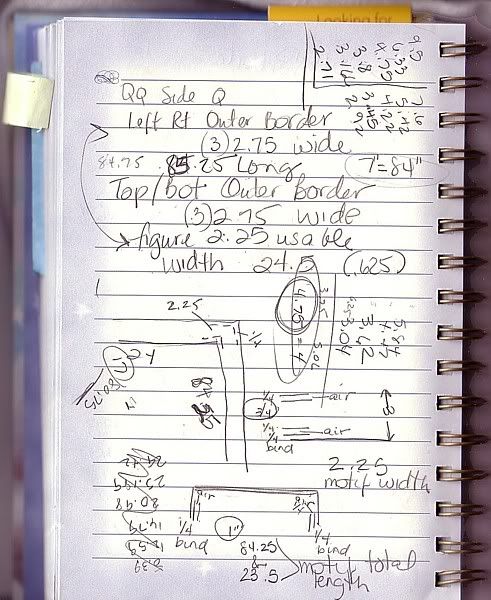
Okay, I got out the small panel and measured it.  From seam to raw edge, all 4 borders are 3".  Taking away 1/4" for binding and leaving 1/4" *air* on each side of a motif gives me a width of 2.25" with which to work.

Measuring horizontally, I get 24.5", raw-to-raw.

VERTICALLY, I get 85.25".  Is that right? I could have measured incorrectly (there aren't many uncluttered places that are 7' long or longer in my house).

Motif Math, part 1 Through some serious math-gymnastics, listening to Mr. Algebra spouting off just like HE hadn't slept through HIS classes, and a touch of pin-the-tail-on-the-fraction, I've come up with a projected motif size of 2.25 x 9.5".

Okay, true confession here:  The math-nastics actually led me to 2.25 x 4.75", but when I figured out that I was going to hand-draw FORTY motifs for just ONE of the SMALL quilts, I got inventive.  It was either that or a(nother) nap, and it was already 9:30 at night.
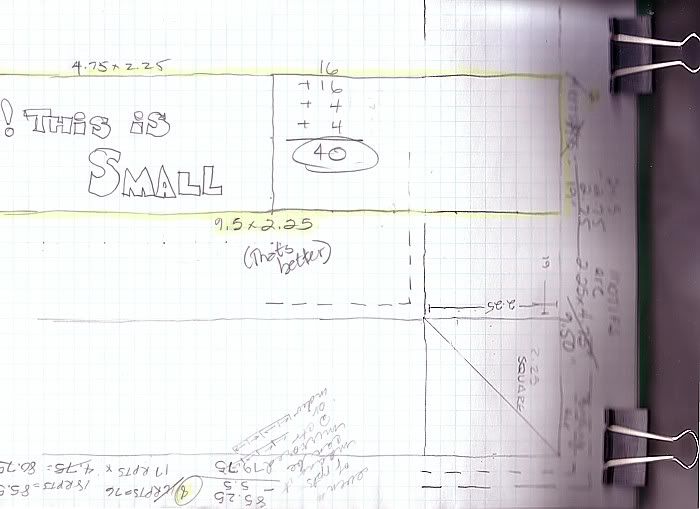
Don't bother trying to figure how my figurin' works out.  It's kinda like a secret ingredient.  Or magic.

Trust me.
Motif Math, Part 2


Next up, going through 5 or 10 inspiration books for... uh... inspiration.

Do you think that we should share the quilting theme?

Re: The Motif Search Begins

Jean wrote:

Yep - 85.25 or 85.5 depending on the amount of stretch. The pattern is right between the two, so I guess we're as close as we're going to get.

BTW, the side borders were cut at 3.25, while the top and bottom borders were cut at 2.75, so all 4 borders aren't 3" unless the top and bottom have grown. Be careful. From seam to raw edge, top and bottom should be 2.5.

Maybe share the theme of the quilting a little later. It's only the beg of Feb. Hard to believe we've just started the 2nd month. Well, okay, the first week is gone, and there's only 3 weeks in March.

Talk about tedium. I've been taping and taping and trimming and taping the rose window. Then bias taping. I just started the third wheel of bias, so for sure we're going to need at least 5. That narrow quilt takes 8 yards just going up and down the white strips.

The Drawing Board

Tracy wrote:

Okay, I had a brilliant inspiration for the quilting pattern for quilt borders. One or two readers even got a preview of said brilliant inspiration.

Oh, brilliant, brilliant, brilliant.

Until I put pencil to paper. After resizing (2.25 x 9.5") and the necessary simplification (so that a human could stitch the pattern) it was, well, boring. Boring and unrecognizable as anything even remotely resembling brilliant. Back to the drawing board.

Here's my drawing board:


Included are things that measure, things to help draw shapes, tracing paper, things that mark things, a major-league eraser-on-a-stick, and the Very Important Things: Coffee and a book on tape. It took 4 Miss Marple short stories to come up with a workable border motif (or two).